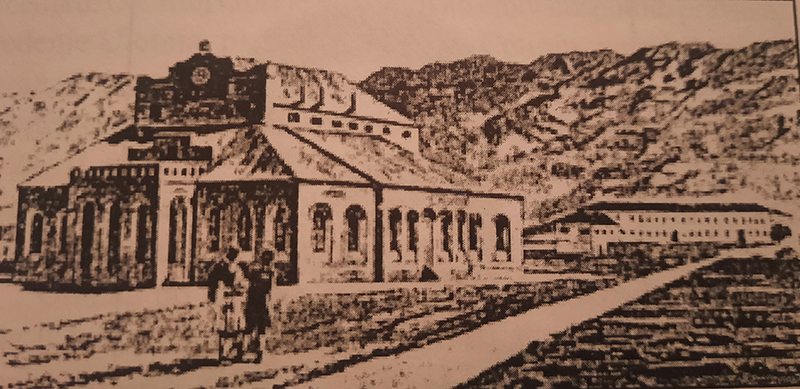
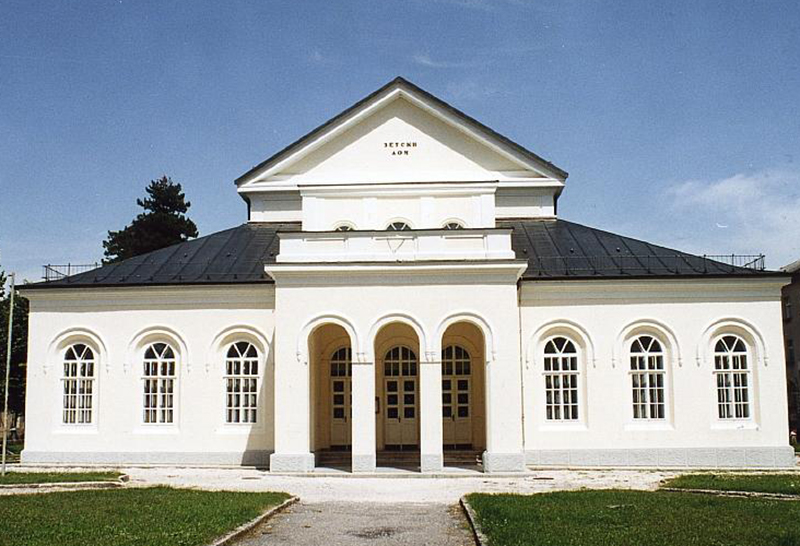
At the end of the World War II, theatre activity was quickly restored in Montenegro. This statement is especially true when it comes to Cetinje, where “Zetski dom” started working only a few days after the liberation (November 13, 1944).
This strategy was developed at the beginning of 1944, when the Art Group headed by Dušan Popović was formed at the session of ZAVNO in Kolašin. It was a forerunner of Montenegrin National Theatre, which, as a state institution, will operate in Cetinje from November of that year. In the same month, the newly formed ensemble played the first piece in “Zetski dom”. It was the play “Vukac Paštrović”, a dramatization of the text by Stjepan Mitrov Ljubiša, which was directed by Miloš Jeknić.
From November 1944 to March 1945, there were 12 plays on the programme at “Zetski dom”, but equally important were the first post-war tours of the theatre – often close to the war operations, which were still ongoing. First, in February and March, 25 plays were performed in Montenegro, Bosnia and Herzegovina and Croatia, and were attended by a total of 19 thousand visitors. April was marked by a tour in Albania. A total of 11 plays were performed in Tirana, Elbasan, Shkodër, Korča and Podgradec.
In the first half of 1945, Vladimir Dudo Špilar was appointed as the general director of the Theatre, and the collective had 31 members, and by the following year that number would be almost doubled.
It is important to mention that the director Vasilije Šćućkin came to Cetinje in the middle of 1945, and his work with young people influenced that the Pioneer Theatre also operated in “Zetski dom” from 1947. In addition, in 1950, the Drama Studio was founded at “Zetski dom”.
After successful tours, the National Theatre was dedicated to the first post-war season, which began on July 10, 1945, with the premiere of the play “People’s Deputy”. During the 1945/46 season, the audience at “Zetski dom” attended 51 performances of the National Theater, but the ensemble was equally active in guest performances. During the summer of 1945, a big tour was organized in nine Montenegrin cities – with 33 plays performed. The following year, from March to July, the theatre toured almost continuously in Podgorica, Ulcinj, Bar, Petrovac, Budva, Kotor, Risan, Tivat, Herceg Novi, Nikšić, Šavnik, Pljevlja, Bijelo Polje, Berane, Andrijevica, Kolašin, Dubrovnik , Lastovo and Prijepolje. It was the longest tour, during which 111 plays were performed.
Season 1946/47. The National Theatre had new general director, Milutin Plamenac, who will soon be replaced with Danilo Lekić. With him, the former director of the Serbian National Theatre Aleksandar Vereščagin came to Cetinje, whose presence influenced both the repertoire and the organization. During the season, the acting ensemble was divided into two groups – the first performed on the main stage in “Zetski dom”, and the second was in charge of tours. During this season, 55 plays were performed in Cetinje, and for the first time the acting ensemble performed in the surrounding places – such as Rijeka Crnojevića, Ljubotinj and Čevo, where the audience saw the play “Suspicious Character”.
The next season (1947/48) will be remembered for a record. Namely, from October 1947 to July 1948, the ensemble of the National Theatre performed in “Zetski dom” and on tours a total of 202 plays, which were attended by 75,222 spectators. Radio Titograd has additionally started to contribute to the affirmation of dramatic forms in Montenegro, where professional actors read radio dramas. In addition, in 1947, the newspaper “Theatre” was published in Montenegro.
Season 1948/49 was opened with the premiere of the play “Duboki korijeni” (director: Dušan Popović). It this season 66 plays were performed in “Zetski dom” and 54 guest appearances. During the next season (1949/50), 140 plays were performed, and the performances in Croatia were particularly notable – the ensemble of the National Theatre performed there in front of audiences in Split, Šibenik, Zadar, Sinj, Knin and Metković. In theatre season 1950/51 seven premieres and 118 plays were performed in “Zetski dom” and 11 other Montenegrin cities.
Number of performances in the theatre season 1951/52 was higher than the previous one (128), with nine premieres. The piece “The Mountain Wreath”, which was directed by Miro Kopač and Mirko Simić on the occasion of the centenary of Njegoš’s death, was particularly notable. The ensemble of the theatre performed 146 plays in the 1952/53 season, with 12 premieres, but in the following season their number was considerably smaller (91 performances, 10 premieres).
The summer of 1954 will mark the 70th anniversary of the founding of the National Theatre. On that occasion, on July 14 and 15, the play “Šćepan Mali” (text: Petar II Petrović Njegoš; Director: Boško Bošković) was performed twice on the Cetinje Summer Stage.
The celebration, however, will be overshadowed by the transformation of the theatre network in Montenegro, which began in April 1954. The Executive Council of the NRCG then issued a Decision on the declaration of the National Theatre in Cetinje as an institution with independent financing.
The National Theatre performed 141 plays in the 1954/55 season. Namely, in 1955, the Decision on the termination of the work of the National Theatre in Cetinje as a republican institution with independent financing became valid. Although the Cetinje theatre formally still had the status of professional, its future became quite clear.
In the biography of “Zetski dom”, the year 1955 is also associated with the foundation of the Puppet Theatre. In the period from 1944 to 1955, in addition to the already mentioned Vladimir Špilar, Milutin Plamenac and Danilo Lekić, the general directors of the Cetinje National Theatre were also Dušan Popović, Miroslav Dedić, Radonja Vešović, Junus Međedović and Savo Vukmanović.